Monday, March 19, 2018

Dog Cancer Series Documentary


A new documentary was just released for pet lovers and veterinarians alike. The Dog Cancer Series - Rethinking the Canine Epidemic is a six hour documentary now available on DVD and will also be available for digital download very soon. It was co-produced by Karen Becker, DVM and Rodney Habib.

Dr. Becker is well known from Mercola Healthy Pets, which is the most viewed pet health website in the world. She is also the author of Real Foods for Healthy Dogs and Cats: Simple Homemade Food.

Rodney Habib is well known to pet lovers everywhere from his Facebook page Planet Paws, which is the largest Facebook pet health site worldwide. He also has a website with the same name.

It took them a year and over 25,000 miles to create this much needed documentary so they can bring awareness to the devastating epidemic of cancer in dogs. Another reason they created it is "to provide pet owners with the most relevant and impactful advice currently available from the top oncologists, researchers and veterinarians in the world." Another priority, Dr. Becker says, is to also get this information into the hands of veterinarians as this is information that is not taught in veterinary schools.

I've seen it and highly recommend it. It contains a lot of great information!

You can learn more about it, watch the trailer, and sign up for a free workshop they've created by going here:  https://www.dogcancerseries.com/  (The free workshop is great too!)

You can also listen to a 20 minute interview of them talking about their new documentary by going here:

https://healthypets.mercola.com/sites/healthypets/archive/2018/03/12/dr-becker-rodney-habib-documentary.aspx

👉 Special Offer for Our Clients: I highly encourage all dog lovers (and veterinarians) to watch this informative and eye opening documentary. In an effort to make it easily accessible for you to do so, I have it on DVD (4 DVD Set)  and will be happy to loan it to you. Just send me an email!

Wednesday, March 14, 2018

How You Store Kibble Matters


 I am not a proponent of dry food to begin with (the more I've learned, the less I like it), but some of the ways in which I see people storing dry pet foods are less than ideal. How you store your pet's dry food does matter.

Dry pet foods (which by the way, are technically and legally considered feed not food) are highly processed. Because they are highly processed and use preservatives, they are packaged and stored in bags that are intended to keep them as fresh as possible until the expiration date or shelf life, which can be between one and three years. (Always check the expiration or "best by" date.)

Some of the dietary fats in dry kibble -- fats that pets require -- are very sensitive to air, heat and time. As soon as a bag of kibble is opened, those fats begin to go rancid. Pouring the kibble from the bag to a container, or into a bowl accelerates the process as the kibble is exposed to more air each time. The more exposure to air or heat, the quicker the fats will go rancid.

In addition to that, in the final step of the kibble production process, palatability enhancers are sprayed on the food (because few animals would eat it otherwise), which consist of metal oxides and sulfates that promote the oxidation of fats.

Most bags of dry food have either a plastic or foil liner on the inside of the bag for this reason. The packaging is protecting the food from air (oxygen), heat and moisture. No matter what type of preservative is used in your pet's kibble, it can quickly turn rancid if exposed to air and hot temperatures. Dry pet foods are supposed to be stored in a cool (under 80 degrees), dry place, which (especially here in the South) does not mean the garage.

Sometimes there is the issue of bugs getting into the food which is why people began putting the food in other containers to store it. But instead of pouring the food out of the bag into a container, it's much better to leave the food in the bag and put the bag in a container. It will stay fresher this way. Remember, each time you expose the food/feed to air, the quicker the fats become rancid.

I have seen dry pet food stored in all kinds of containers. The most popular is plastic of course. What most people don't think about is whether or not the plastic your storing the food in is even food grade plastic. The food items we buy for ourselves as well as pet foods, are stored in food grade plastics. Are you using food grade containers to store your pets' food? 

Even so, most (if not all) plastics can leach toxic chemicals into the contents of the container. (Which is why after learning this I stopped using plastic for food storage altogether.) Also, some plastics can actually absorb much of the vitamin C out of the food; it leaches out and gets sucked into the plastic material. This effects shelf life as it causes the fat to oxidize and accelerates spoilage. Another reason to leave it in the bag.

Bisphenol A (BPA) is a chemical that can be found in many plastic containers, including food-grade plastics. BPA has been shown in several medical studies to be harmful and may even cause cancer. BPA has been linked to thyroid and neurological problems. 

And if you think you're out of the woods by getting BPA-free plastic, better think again. Studies have found that some BPA-free plastics have similar estrogenic activity as plastics with BPA, which cause adverse health problems.

Another reason to leave it in the bag.

Another two important reasons why keeping it in the bag is a good idea: One is that the bags, which were made specifically to keep the food fresh as possible for as long as possible, would likely keep the food fresher longer than it would after being poured into another container (letting air in), which is likely to allow for more space (air) as the food level gets lower. A bag you can roll down to keep the air out!  Two: In case of a recall of the food. If your pet ever gets sick and you suspect the food (or treats), you will need the product information code and expiration date on the package. Or if there is a recall on the food you buy, you will need to know the information on the packaging. This is important! Pet food recalls happen on a frequent basis.

You can follow Cozy Critters Facebook page to get notices of pet food or treat recalls.

Buying too much dry food at a time might save you a few dollars or a few trips to the store, but it may also be causing your pet's food to go rancid quicker. Just how long does that bag last? (More than seven days?) Does it last so long it's most likely stale or rancid once you get to the bottom of the bag because it's been opened and exposed to air so many times? You might want to consider buying in smaller quantities so it's always as fresh as possible. If not, be sure to at least keep the bag closed tightly after letting the air out. 

If you ever notice that the food looks or smells funny, don't feed it to them. Better safe than sorry. You may not even notice anything different when a food has actually turned rancid. If your pet refuses to eat something, don't make them. Animals can sometimes smell when there is something "off" with the food and know not to eat it. We forget sometimes to give more credit to the animals.Their sense of smell is much more powerful than ours! 

If you continue pouring your dry pet food in a plastic container, at least be sure to wash it out and dry it thoroughly before putting a new refill of food in. If you dump new, fresh food on top of remnants of old, rancid food, those remnants of oxidizing old food can spread the oxidation to the new food. 

We need to be more conscious of how we store our pets' food in order to help them stay healthy. How you store their kibble matters. 

Monday, February 12, 2018

Celebrating 16 Years in Business


Cozy Critters Pet Sitters is

Proud to be Celebrating 16 Years in Business!


Caring for Pets is our Passion!


T H A N K    Y O U ! 

for choosing us as your 

Professional 


Wednesday, January 10, 2018

Food Intolerances and Sensitivities


Does your pet have itchy skin, rashes, hot spots, chronic ear infections, diarrhea, or gas and you just can't seem to find the root of the problem?

Did you know that although actual food allergies are rare, food intolerance is the third most common sensitivity condition in dogs and cats? The difficulty has always been figuring out what foods are the culprits though -- until now.

NutriScan is the most accurate food sensitivity and intolerance test on the market. It is the only clinically predictable veterinarian diagnostic test for dogs, cats and horses. Developed by world renowned veterinarian Dr. Jean Dodds, this patented test, which can be done at home or at your vet's office, looks at particular antibody responses for 24 of the most commonly ingested foods by dogs and cats (or horses). Again, this is not an allergy test, but a sensitivity and intolerance test, which is looking at different antibodies than you would an allergy test.

You can find out more about this wonderful new alternative to food elimination trials, skin patch testing and serum-based food allergy testing by going to http://www.nutriscan.org/ .

Check out some of the case studies and see if they don't sound familiar; and find out what a difference this test made for the lives of these pets!

Dr. Dodd's scientific report on NutriScan, which was published in the AHVMA Journal is available to read here:  

https://gallery.mailchimp.com/65fe703d8ce705ddce0e30120/files/8e49143a-c983-43a1-a795-8271fcc3fd0c/AHVMA_Winter_2017._2018_Volume_49.pdf

My favorite holistic veterinarian Dr. Karen Becker discusses NutriScan with Dr. Dodds in these short videos, as well as sharing some very exciting news on a new veterinarian diagnostic tool Dr. Dodds has been working on. 

Wednesday, January 3, 2018

Redemption


In a previous post I wrote about an excellent book that was a real eye opener when it comes to animal shelters in this country, called Redemption by Nathan Winograd. This book won five national book awards and redefined the animal protection movement in this country.

Nathan is the founder and director of No Kill Advocacy Center. He brought to our attention and awareness the truth about why there are still 3 to 4 million animals that are killed in our animal shelters every year. And as you'll learn, it's not because there aren't enough homes for them all, like we've been told. 

Nathan and his non-profit No Kill Advocacy Center have been doing great work since 2004 in helping to change our sheltering system to No-Kill shelters. Check out the animal shelters that have been reformed in our own state of Texas! We need them all to be like this! (Not in Texas? Look up your state by going here.)

Please check out No Kill Advocacy Center's website and consider supporting them!

And now Nathan's book Redemption has been made into a movie! 

Friday, August 18, 2017

Beware of Coyotes


Just in the last few months I have received three separate reports of coyotes being spotted -- one in West University and two in Meyerland. One of them in Meyerland was caught on video killing the family's cat in their front yard. We lost a cat ourselves in 2012 to a coyote. They typically travel along train tracks, ditches and bayous, but have been seen wandering through neighborhoods. I've spotted one running along the ditch before and one of my clients (also in Bellaire) who lived two blocks from the railroad tracks on a corner lot saw a coyote laying in his front yard once.

Please be aware especially if you have cats or small dogs and keep them indoors at night.

Here's an article with tips on how to keep your pets safe from coyotes:

http://www.adoptapet.com/blog/keep-your-pets-safe-from-coyotes/

Thursday, August 10, 2017

Air Fresheners

Too many people do not realize (or just don't think about) that commercial air fresheners are full of toxic chemicals. When you use these in your home, you are literally spreading a myriad of toxic chemicals into the air you and your pets breathe. 

Whether an aerosol, solid, or plug-in, these air “fresheners” release volatile organic compounds (VOCs) into the air. Aerosols disperse the chemicals as a fine mist. Once in the air the tiny particles may be inhaled and are able to penetrate deep into the lungs. VOCs, such as limonene and pinene are released from solid air fresheners and plug-ins. Studies show these chemicals, released in a gaseous state, mix with ground level ozone to create ultra-fine particulate matter, as well as formaldehyde, a known carcinogen.

Some of the most offensive VOCs like benzene and formaldehyde can cause headaches and nausea and aggravate asthma, and have been linked to neurological damage and cancer.

In a 2010 University of Washington study, they found "that eight unnamed, widely used U.S. air fresheners released an average of 18 chemicals into the air. On average, one in five of these chemicals were hazardous substances highlighted in federal and some state pollution standards. Fully half the air fresheners tested released acetaldehyde, a likely human carcinogen according to the EPA."

When Environmental Working Group (EWG.org) conducted more sensitive testing of the air freshener Febreze Air Effects as part of a 2009 study of cleaning supplies used in California schools, they detected a total of 89 airborne contaminants, including acetaldehyde.

EWG also did the first study of its kind in 2008 testing companion animals for chemicals. In their report Polluted Pets, they concluded "The body burden testing conducted in this investigation is the most expansive ever published for companion animals. The study indicates that cats and dogs are exposed to complex mixtures of industrial chemicals, often at levels far in excess of those found in people. Our pets well may be serving as sentinels for our own health, as they breathe in, ingest or absorb the same chemicals that are in our environments. Exposures that pose risks for pets pose risks for human health as well. A new system of public health protections that required companies to prove chemicals are safe before they are sold would help protect all of us, including the pets we love." You can read the full report here.

Research from the National Institute of Environmental Health Sciences suggests that the
"fresh" smell of many air fresheners is a result of the ingredient 1,4 dichlorobenzene (1,4 DCB) which has been found to impair lung function.

Ingredients commonly used in fragrances in air fresheners include phthalates.Toxic phthalates found in air fresheners:

• Di-ethyl Phthalate (DEP): Associated with changes in           hormone levels and genital development in humans.
• Di-n-butyl Phthalate (DBP): Recognized as a reproductive   toxicant by the National Toxicology Program and the State of California. It can lead to       changes in genital development.
• Di-isobutyl Phthalate (DIBP): Associated with changes in male genital development.
• Di-methyl Phthalate (DMP): Inconclusive evidence has shown reproductive toxicity in     animal studies.
• Di-isohexyl Phthalate (DIHP): Limited toxicity testing has shown that DIHP is probably   a developmental and reproductive toxicant.

🕱🕱🕱🕱🕱🕱🕱🕱🕱🕱🕱🕱🕱🕱🕱🕱🕱🕱🕱🕱🕱🕱🕱🕱🕱🕱🕱🕱🕱🕱🕱🕱🕱🕱🕱🕱🕱🕱🕱🕱🕱🕱🕱🕱🕱🕱🕱🕱🕱🕱🕱🕱🕱🕱🕱🕱🕱
Fragrance: Diethyl phthalate (DEP) is often used as part of the "fragrance" in some products. Since DEP won't be listed separately, you're better off choosing personal care products, detergents, and cleansers that don't have the word "fragrance" on the ingredients list.
🕱🕱🕱🕱🕱🕱🕱🕱🕱🕱🕱🕱🕱🕱🕱🕱🕱🕱🕱🕱🕱🕱🕱🕱🕱🕱🕱🕱🕱🕱🕱🕱🕱🕱🕱🕱🕱🕱🕱🕱🕱🕱🕱🕱🕱🕱🕱🕱🕱🕱🕱🕱🕱🕱🕱🕱🕱🕱🕱


According to National Geographic’s The Green Guide, many air fresheners contain nerve-deadening chemicals that coat your nasal passages and temporarily block your sense of smell. So just imagine what happens when they are used continuously. I have noticed this about some people...they don't smell things like I do. Some people seem to have no sense of smell left at all. 

Case in point: I had a client -- a retired couple, who just had one pet, a Bichon Frise. Their dog was kept in the den and utility room area, which was tiled. The dog had been diagnosed with epilepsy some years ago and was on several medications which kept her pretty doped up. Sometimes she had accidents on the floor. To my horror, I discovered they had 8 to 10 automatic spray air fresheners in the house, mostly in the dog's room and adjoining rooms. They would spray me as I walked past. One was sitting right above the dog's bowls so that when it sprayed, it went directly in her food and water. For this and other reasons I got permission to keep this dog at my house whenever they were out of town, which I normally don't do. The smell of air fresheners was so strong in the house it was unbearable. It obviously didn't even bother them. (Imagine the amount of chemicals they are all breathing!) 

And once, when I was returning their dog home, I managed to show up right after their housekeeper had left. Just getting out of my car, I was standing in the driveway, a few feet away from the door, and I could smell Pine-Sol (another poison) so strong, it was knocking me out and I haven't even opened the door yet! I had to wear a mask to go inside and open up another door to let some fresh air in. This was in addition to the air fresheners! The indoor air my clients thought nothing of breathing, (or of their dog breathing) was enough to make me sick. They obviously had little to no sense of smell left and no wonder why! And is it any wonder their dog suffered from epilepsy? OMG. Even after I left them a note along with articles explaining what the air fresheners consist of and are doing to their dog and to them (and how it knocked me out), the next time I went back I noticed they had cut the air fresheners down to half of what they had.They just didn't get it.

My sense of smell is very sensitive. I don't use commercial air fresheners, dryer sheets or products that contain the ingredient "fragrance". I read the ingredients of all products I buy. I use "green" and natural products including essential oils. I also use unscented cat litters and my own litter box deodorizer made with baking soda and a blend of essential oils which I offer here. Being a highly sensitive person, these and other smells are overwhelming to me and affect me physically. Even too many strong smelling candles can be too much for me. And just because someone else may not be as sensitive, it doesn't mean it's harming them any less.  


And considering that our pets' sense of smell is thousands of times stronger than ours, with dogs having 125 to 300 million smell receptors, cats having 45 to 80 million, compared to humans, who have 5 million, they are affected even more so. Not to mention our pets can be at nose level to plug-ins and they are always close to the ground where everything settles. Add the "fragrance" in scented cat litters and commercial litter box deodorizers to the air fresheners and cleaning products and you've got an enormous toxic soup for indoor air, which isn't healthy for animals (who come from nature where all these things don't exist!) or us humans.

The chemicals emitted from air fresheners (and other toxic products) accumulate in the fatty tissues over time, so the danger increases as they build up inside a body. 

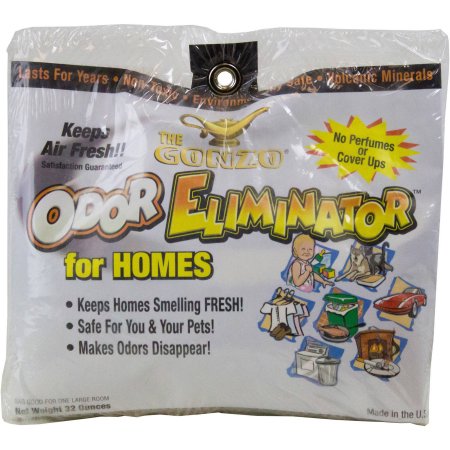
In addition to using things like baking soda, vinegar, green products and products made with essential oils like my litter box deodorizer and the air freshener available on my shop page, another natural and safe deodorizer, Zeolite, is a mineral that absorbs odor even more efficiently than baking soda. Use powder form (such as Odorzout) as you would baking soda. Zeolite pebbles or stones (photo below) can be placed in problems areas and recharged in sunlight. They are available at various online stores as well as places like Walmart and Home Depot.
Zeolite

References: 
Ecocenter.org
EWG.org
Scientificamerican.com
Healthwyze.org
Toxipedia.org
HSPerson.com